A bad poem in Midgaard catches the first ash of a larger story.
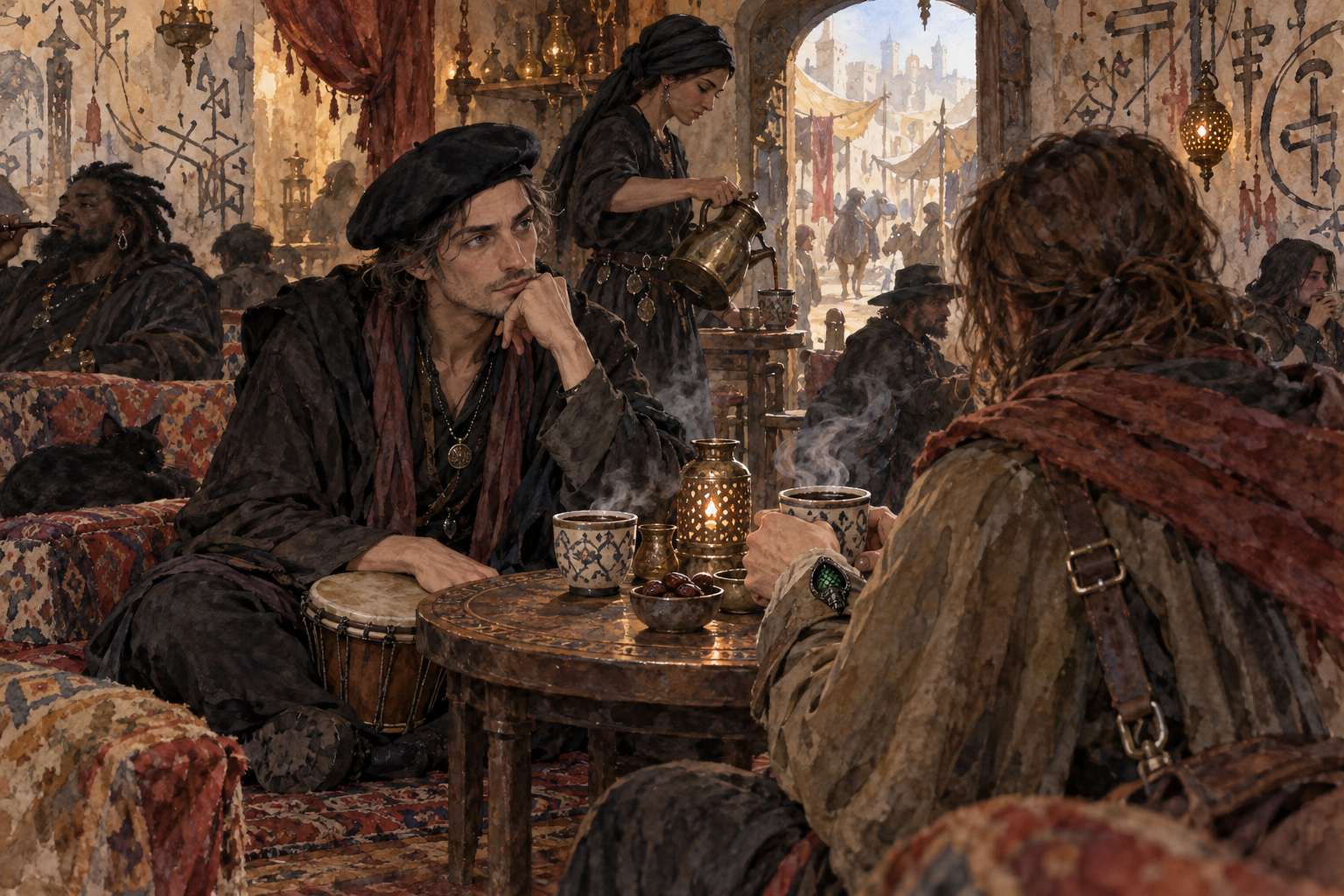
The beat poet woke on a cushion that did not belong to him, beneath a wall of frantic writing nobody in the cafe had finished reading. He knew this because he had tried, once, after three mochas and a dare from the quickling. The words had started out holy and ended up crawling into the machinery of night, and by morning he had decided that all great art was either prophecy or bad handwriting.
His bongo drum sat between his knees. He tapped it once, softly, to see if the day was still hollow.
North, Market Road breathed dust through the doorway. Midgaard was waking in its usual order: merchants first, guards second, trouble whenever it felt like it. Somewhere beyond Common Square there was a grate, and beyond that, the dark places people only mentioned when they were trying to sound brave. The poet knew the map by rumor: Dragon Cult, Rats Lair, Grubby Inn, Dump, South Bridge. Every city had a heart, but Midgaard had several, and most of them beat under floorboards.
He looked past the first customer of the morning with grey eyes under his black beret and gave the room what it had paid nothing to hear.
"Girl---friend," he said. "My---friend?"
The customer winced. Good. Art had entered the body.
Luthor poured coffee with the calm of a man who had seen worse than verse before breakfast. The quickling shook on the floor and asked six questions without waiting for any answers. The poet smoked, coughed, and watched the black-clad regulars pretend not to listen. They always listened. That was the cafe's central lie.
Around noon, a traveler came in smelling of river fog and burnt leaves. Not smoke. Not exactly. Burnt green things. The poet noticed because poets notice what civilized people step over. There was a scale caught in the traveler's cuff, no bigger than a thumbnail, green as old bottle glass and rimmed with black. When the traveler sat, the room went briefly quiet in the way rooms do when everyone hears the same sound but no one agrees to name it.
"Bad crop year south of the bridge," the traveler told Luthor. "Fields yellow at the edges. Crows won't land."
"Crows are critics," said the poet.
Nobody laughed, which meant he had accidentally said something true.
By evening, the scale was gone. Maybe swept away. Maybe pocketed. Maybe never there. The poet tapped his bongo until the cafe became a little storm of fingers, cups, boots, breath. He thought of the Dragon Cult marked in the city's southern gossip like a stain no washing could lift. He thought of green fire, though he had never seen any. He thought of fields yellowing for reasons farmers would blame on weather, taxes, gods, wives, and soil before they blamed the absence of one old terror from the sky.
Then he stood, because standing made even nonsense sound official.
"She's jag---ged," he told the room. "And blas---ted."
A bar maid rolled her eyes. Luthor polished a mug. The quickling whispered, "Groovy, maaaaan," to nobody at all.
Outside, Midgaard kept moving. Guards watched gates. Thieves watched guards. Somewhere south, something that should have been afraid was not afraid yet.
The beat poet beat his drum again, softer this time, and listened for the answer under the city.