On the Mob Factory's late shift, an exhausted worker finds one finished unit too many and a production tally that insists there is no surplus.
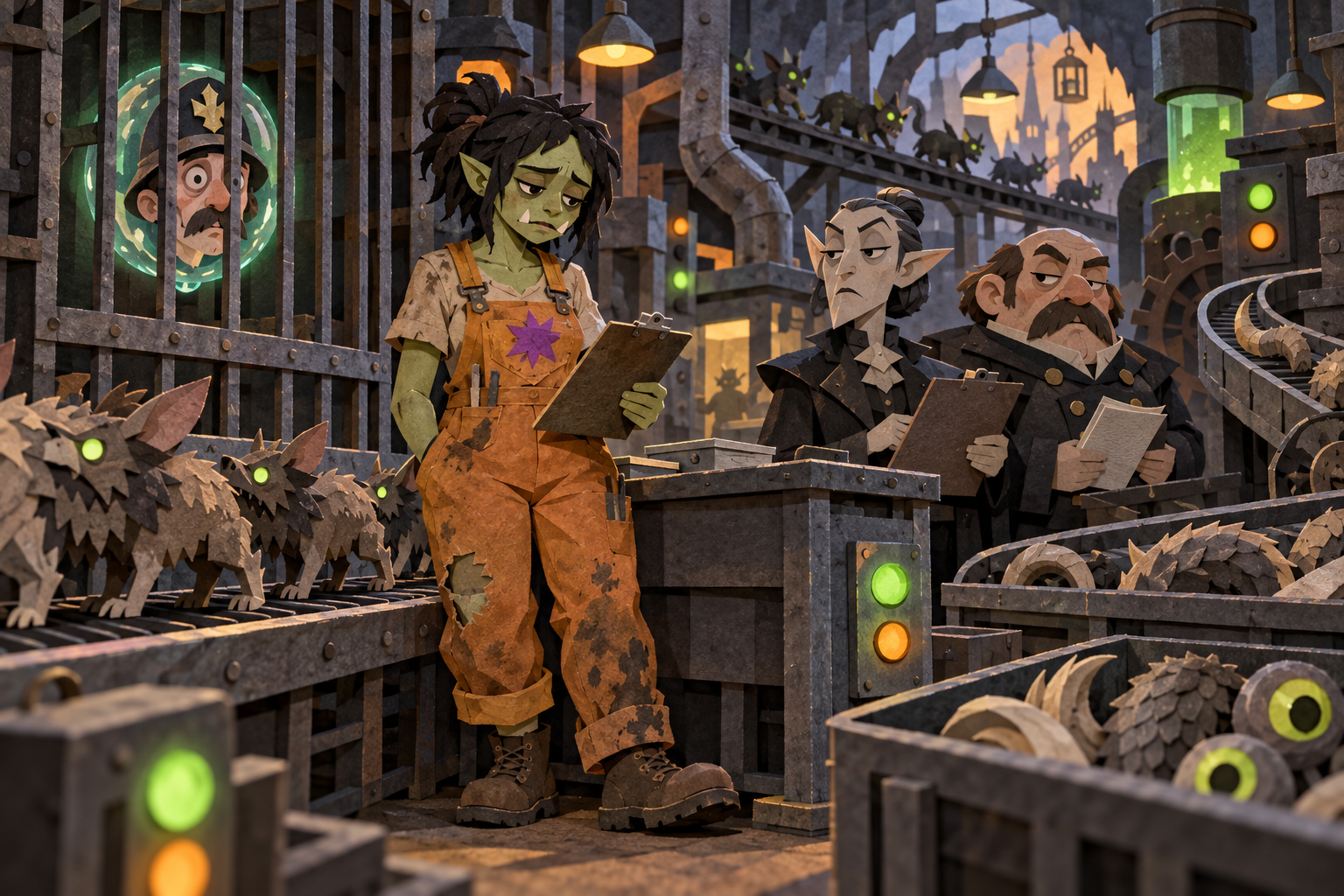
The late-shift worker could sleep anywhere the Mob Factory allowed a chair.
That was not the same as sleeping well.
She had slept in the cafeteria through spilled drinks, in storage while mutant fidos scratched at the next door, and once in the reject room until a deformed shape beside her began snoring in the same rhythm. Tonight she woke at the inspection desk with her cheek stuck to a production form and the machinery stamping its steady headache through the floor.
Her orange overalls had creased around the bright purple starburst over her heart. She rubbed the ink from her tusk, checked that Foreman Floyd was not standing behind her, and read the form she had used as a pillow.
LATE SHIFT. URGENT REPLACEMENT STOCK.
The line beyond the inspection cages was already moving.
The Mob Factory made danger practical. Wild monsters needed caves, nests, grudges, and years of poor decisions. Factory monsters needed parts, paint, a destination tag, and someone willing to stamp PASSED without asking where the teeth had come from.
The Midgaard Inspections Bureau sent teams for that last part.
Two inspectors stood across the room trying to look busy. One held a clipboard upside down. The other watched a cityguard head float past the cage bars and made a mark without checking which box his pencil had found.
"Defect," the worker said.
The head drifted in a slow circle. Its teeth clicked at her sleeve.
"Mobile," said the first inspector.
"No body."
"Efficient."
"It is trying to eat my checklist."
"Initiative."
She caught the head by one ear and turned its destination tag toward him. MIDGAARD. NIGHT SHIPMENT. The stamp beneath it was still wet.
"Passed," he said.
She let go. The head bit the corner from his clipboard.
"Passed with note," he corrected.
This was an ordinary beginning.
The next hours arrived on belts. Mutant fidos with green eyes came first, each glaring as if quality control had offended its ancestors. A revolving drunk spun through twice because no one could agree which side counted as forward. Toxic slime leaked from an inspection cage and ate the leg from an empty stool. The workers mopped around it without enthusiasm.
The late-shift worker checked joints, counted limbs, and tied destination tags where the machinery had missed. She rejected one fido for having six excellent legs and another for having only a tail. The inspectors passed both after deciding that the average was correct.
Beyond them, the primary assembly line shook the walls. The secondary line carried cityguard heads with the cheerful efficiency of a bakery moving rolls. Farther east, the overflow floor had filled every feeder track. Painted limbs slid beneath stamping hammers. Crates of synthetic fur crossed behind curtains of sparks. Workers shouted numbers over the noise and heard whichever numbers kept production moving.
Shortly after midnight, an alarm began chirping at the east end.
It did this every few seconds, which made it less alarming and more like a small metal bird everyone wanted dead.
"Inspection backup," one worker shouted.
"Dispatch says no room," shouted another.
"Reject says plenty."
The late-shift worker looked south toward the reject room. Incorrectly made mobs waited there for destruction. The room always had plenty.
She took her clipboard and followed the belts east.
The overflow assembly line smelled of solvent, hot glue, and fur that had never belonged to an animal. Crates marked URGENT REPLACEMENT STOCK leaned against one wall. At the workbenches, fractured masks and rejected heads stared in several unfinished directions. On a support pillar, someone had chalked enough kill tallies to make the building seem proud of itself.
A foreman's note had been pinned above a row of half-assembled drunks and fidos.
SHIP THEM ANYWAY.
No signature was needed.
At the serial checkpoint, diagnostic lamps flashed over each finished body. A worker stamped a number. Another tied a destination tag. The unit rolled on toward the loading track, where replacement mobs were packed for Midgaard.
The late-shift worker found the problem between two ordinary crates.
It wore orange overalls.
The cloth was new except for a torn left knee. A purple starburst had been sewn over the chest, bright against the factory grime. The body lay on its back with both hands folded neatly over its stomach. Female. Orc. Work boots. Tusk tips. Closed eyes.
The same solvent stain marked its right cuff as the one on hers.
She looked down at her knee.
The fabric there had torn an hour earlier when the six-legged fido kicked the cage door. A few loose threads hung from the rip.
A few loose threads hung from the unit's rip.
"Who ordered a worker?" she asked.
Nobody answered at first. The factory was excellent at making noise and poor at admitting responsibility.
The stamper checked his slate. "No worker due."
"Then why is there one on the line?"
"If it is on the line, it was due."
That was factory logic. It had survived longer than several walls.
The late-shift worker stepped beside the unit. Its face was hers after a long shift: tired even with the eyes closed, one cheek marked by the edge of a form. A black ink smudge touched the left tusk.
She wiped her own tusk with one thumb.
The smudge came away.
On the unit, it remained.
The destination tag was tied to its wrist.
MOB FACTORY.
INSPECTION ROOM.
LATE SHIFT.
A metal badge had been pinned to the unit's overalls beneath the tag. Its serial matched the number the late-shift worker knew by heart.
She reached for her badge.
Its number was gone.
The metal still held her name, her shift, and a small dent from the day Foreman Floyd had mistaken her for a defective ogre. Where the number had been, the surface was smooth.
"Stop the belt," she said.
The stamper laughed.
She put one hand between the rollers.
He stopped the belt.
The inspectors arrived after the machinery fell quiet. Silence moved badly through the factory. It collected in the spaces where gears should have ground and left everyone hearing the hum of backup generators, the drip from chemical hoses, and the soft clicking of boxed cityguard teeth.
The first inspector compared the two workers.
"Replacement stock," he decided.
"Replacement for what?"
He pointed at her blank badge.
The second inspector found a form beneath the unit. Every box had been completed. LIMBS. TEETH. MOBILITY. ATTITUDE. DESTINATION. The final line carried the late-shift worker's signature.
She had not signed it.
The handwriting had the weary downward slope hers acquired near dawn.
The unit opened its eyes.
They were not glowing, empty, or wrong. They were her eyes. They focused on the ceiling, then the inspectors, then her.
"Am I late?" it asked.
The belt workers backed away.
The inspectors did not. They had forms proving this was somebody else's concern.
"Reject room," the late-shift worker said.
The unit sat up. "Plenty of room there."
It knew the joke. That frightened her more than the face.
They moved it south on a hand cart. Past the checkpoint, where the production count flashed one unit complete. Past the inspection cages, where the cityguard head had finished eating the inspector's clipboard. Past the entrance hallway, where the machinery sounded loud enough to hide any answer.
At the reject-room door, the unit looked at the deformed shapes waiting beyond.
"Subsequent destruction," it read from the warning sign.
"You know what this place is?"
"We know our destinations."
"This is not your destination."
The unit looked at the late-shift worker's blank badge.
"It might be yours."
Behind them, the factory alarm stopped chirping.
Every production board changed at once.
One worker short.
The message traveled from the overflow line to inspection, from inspection to storage, from storage to the dispatch bay. Red warning lamps blinked in rhythm. Somewhere to the east, a loading gate opened and waited.
The late-shift worker understood the count.
The line had finished a worker. The serial checkpoint had stamped one worker. The factory was owed one worker at inspection and had assigned the number already.
It did not care which body carried it.
She took the unit back.
At the inspection desk, she pinned the blank badge to the unit's overalls and reclaimed the numbered one. Nothing changed. The production board still read one short.
The unit removed the numbered badge from her chest, pinned it to its own, and sat in her chair.
The board cleared.
Machinery restarted throughout the factory. The inspectors stamped the completed form. The cityguard head spat out the last corner of the clipboard and floated toward Midgaard's night shipment.
"Passed," said the first inspector.
The late-shift worker stared at the duplicate in her chair.
"With note," said the second.
By dawn, the overflow backlog was gone. Crates stood stacked to the dispatch-bay rafters, each stenciled with a destination. Gates opened and sent finished mobs into the waking world. The duplicate inspected fidos, drunks, heads, and slime with the same tired competence the late-shift worker had shown all night.
It even knew which stool the slime had eaten.
The late-shift worker went to Foreman Floyd's office. She found no explanation there, only plans for the factory's future and a fresh production report.
Workers on shift: correct.
Workers shipped: correct.
Workers rejected: none.
She carried the report to the cafeteria. The food looked worse than usual. An empty chair waited beside a table covered in spills.
She sat, folded her arms beneath her head, and tried to sleep.
Far away in the overflow dispatch bay, a gate opened again.
This time, no production board recorded what went through.