In Newtonia, a doctoral candidate discovers her half-finished dissertation has begun citing work no one has written yet.
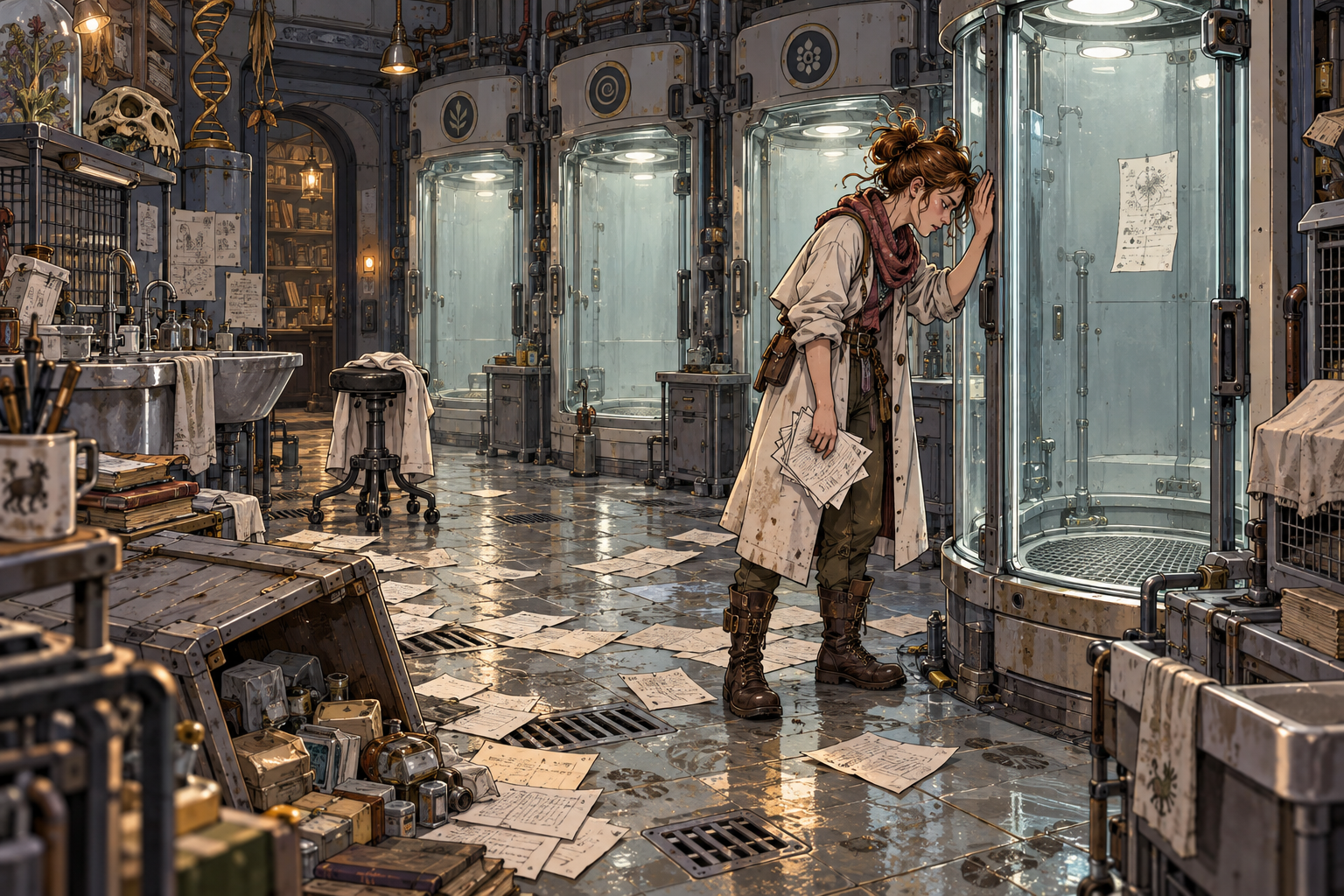
The doctoral candidate had been awake for thirty-one hours, which was not a record, but it was close enough to make the walls breathe.
Newtonia did not sleep around her. That was the first lie the academy told its students: the campus is quiet after midnight. The campus was never quiet. The floors hummed with vibration from machines buried behind locked doors. The BioGenetics Laboratory clicked, hissed, rinsed, drained, and clicked again. Somewhere behind a counter, a cage rattled once and then stopped, as if whatever lived inside had remembered it was being observed. The isolation chambers held their own reflections in the glass, four pale rooms waiting for mistakes.
She sat on an overturned supply crate with her half-finished dissertation balanced across both knees.
Half-finished was charitable. Half alive was closer.
The title had changed three times since dinner. At sunset it had been The Effects of Quantum Energy on Directed Biological Variance, which sounded like something a committee might approve if the coffee was strong. By midnight it had become The Effects of Quantum Energy on Your Body, with the words your body underlined twice in a hand she recognized but did not remember using. By the hour when even the head researchers stopped pretending they were supervising anyone, the title page had gone blank except for a footnote mark.
There was no sentence above it. Just the small raised number, smug and precise.
She turned to the bottom of the page.
1. See Vell, T., "Why the Subject Screamed Before the Test Began," Newtonia Proceedings, forthcoming.
She stared at the citation until her eyes watered.
There was no T. Vell in her department. There was no Newtonia Proceedings. There was, as far as she knew, no accepted academic category for screaming before a test began, though she had personally contributed data in that field every week since enrollment.
A vibration hummed up through the floor.
Her stack of pages slid from her lap and fanned across the tile.
"No," she said, which was not a spell, not a theory, and not nearly enough.
She crawled after them before the drains could drink her methods section. Page twelve had landed under a sink. Page forty-two had folded itself neatly beside a cage. Page seven was stuck to the glass of an isolation chamber from the inside.
That chamber was empty.
She pressed her palm against the glass. The page trembled but did not fall. A new line appeared at the top, ink darkening from invisible to wet black:
The subject will deny authorship.
"I deny everything," she whispered.
The line added: See Appendix C.
There was no Appendix C. She knew because Appendix A was a drawing of a machine she could not afford, and Appendix B was three pages of apologies to her advisor, her future advisor, and whatever replaced both of them after review. She gathered the scattered sheets with shaking hands and found Appendix C already stapled to the back.
It contained a table of results.
Trial one: candidate applies theory here.
Trial two: candidate says, "Let's find out."
Trial three: door opens without permission.
The laboratory door opened without permission.
No one stood in the hall. The blank little door to the west remained shut. The air beyond it smelled of cleaner, hot dust, and the faint sour terror that got into academic buildings when too many people learned too much from things that should have been left unmeasured.
Her dissertation rustled.
On page eight, a paragraph inserted itself between two sentences about controlled exposure. It was better than anything she had written all month. Clear hypothesis, clean terms, sharp verb. She hated it immediately. She also copied it into her notes before it could change its mind.
The cage on the counter rattled again.
"If you are peer reviewing me," she told the room, "you need to disclose conflicts of interest."
Something scratched once against metal.
The final page slid free from the stack and moved across the floor by itself. Not floating. Not crawling. It advanced in tiny paper shivers, nudged by no wind she could feel, until it stopped at her boot.
At the bottom, beneath a conclusion she had not earned, was one last footnote.
27. The candidate survives if she leaves the third result uncited.
She read it twice. Then a third time, because graduate school had trained her to trust nothing useful until it had hurt her repeatedly.
The dissertation wanted to be completed. That was obvious now. It wanted tables, trials, subjects, dates. It wanted the future laid out in proper format, with margins aligned and every disaster footnoted before it happened. She could almost admire the discipline of it.
Almost.
She tore page eight out of the stack.
The lights flickered. The cages went silent. The page on the inside of the empty chamber peeled itself from the glass and dropped to the floor with a soft slap.
For a moment, nothing happened.
Then every footnote number in the dissertation changed to 3.
The doctoral candidate laughed because the other option was screaming, and screaming had apparently already been claimed by forthcoming literature. She gathered the pages, tucked them under one arm, and stood.
By dawn, she had hidden Appendix C in a locked cabinet, rewritten the title by hand, and added a dedication she did not understand:
For the committee that has not met yet.
When the first researcher arrived, he found her asleep beside the counter, one cheek pressed to the half-finished dissertation. The title page was ordinary again. The footnotes were quiet. Only the margins remained crowded with tiny, careful pencil marks.
Most were corrections.
One was a date.