On the Chessboard, the only man without an army finds one piece the war refuses to claim.
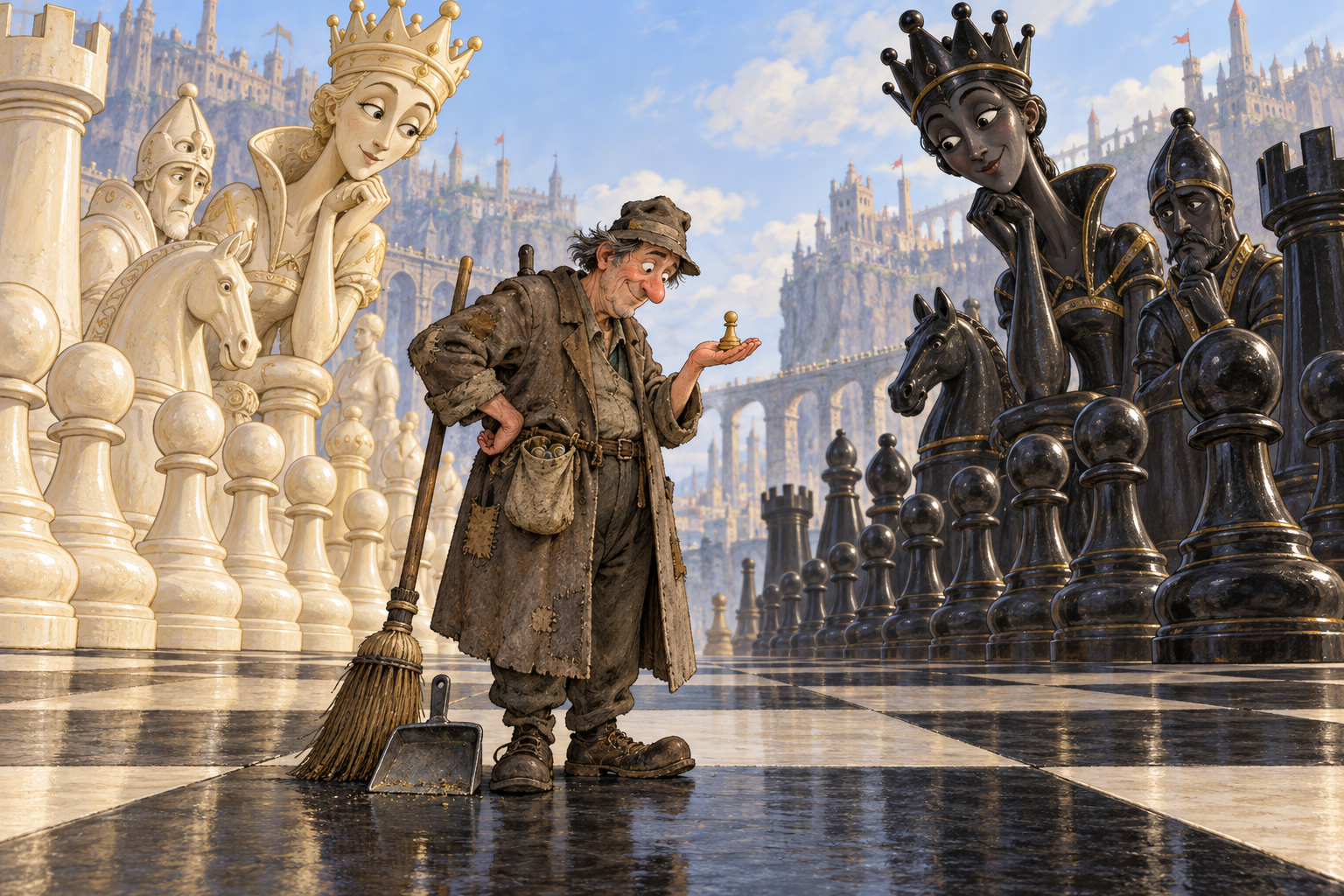
The Chessboard Janitor believed every war, given enough time, became a problem for a broom.
He began each morning on a black square near the south side of the battlefield. Not because he favored black. Yesterday he had begun on white, and the day before that he had awakened under a rook. The board moved everyone except the janitor. His only campaign was against what they left behind.
At dawn the armies found each other.
White pawns peered north in fear of anything dark. Black pawns looked south with the same expression reversed. Ivory knights charged across the ranks on rearing stone horses. Ebony rooks advanced like castles that had grown impatient with geography. The white King watched for the black Queen. The black King watched for the white Queen. Neither watched where he stepped.
The janitor watched everything.
He waited for a white Bishop to finish calling down clean, furious light. He waited for the answering black fire to stop crawling over the square. Then he walked between them, swept two broken spear shafts into his pan, and nudged a pearl rosary out of a puddle before the fighting could grind it into powder.
"Neutrality is cowardice," an ivory knight told him.
"Neutrality is why you can still find your armor," said the janitor.
The knight considered this, found it beneath a fallen pawn, and galloped away without apologizing.
By noon, the board had become noisy with boasts. Every piece had an opinion about the enemy's courage, ancestry, strategy, smell, and likely future as furniture. The janitor let the insults pass over him like weather. He knew the white army by its pale dust, the black army by its dark chips, and both armies by their confidence that someone else would clean up.
He swept six little piles of coins from one square. One pile might be luck. Two might be a wager. Five could still belong to a battle. Six was rubbish. He counted every coin into the canvas sack at his belt. When the sack grew heavy enough, he bundled the sweep and sent it to Thunder at the Temple of Mota, where bloodied travelers asked a goddess to put them back together.
That seemed fair. The board broke people. The board could help pay for repairs.
The afternoon charge began on the east side and folded toward the center. A black Rook went down hard enough to shake three squares. The janitor waited until its enemies moved on, then swept the fallen body into his dustpan and shook it once. A King's sceptre, two coins, and somebody else's marble crown clattered onto the board.
Something else remained in the pan.
It was a pawn no longer than his thumb.
Not ivory. Not ebony. Plain wood, close-grained and warm, with a round head and a narrow base. No knife marks showed where it had been carved. No paint hid the grain. It looked less like a finished piece than an idea the board had not decided how to use.
The janitor held it up.
Every nearby piece stopped shouting.
A white pawn backed away first.
"Black trick," it whispered.
"White spy," said a black pawn from the next square.
"It has no color," the janitor said.
This satisfied neither of them. Color was the first fact on the Chessboard and, for many pieces, the only one.
The white Queen arrived from the north, carved ivory bright beneath battlefield dust. The black Queen came from the west, ebony polished like still water. They usually searched for the opposite King. Now they studied the little wooden pawn in the janitor's palm.
"Mine," said the white Queen.
"Enemy," said the black Queen.
Then, after a pause, they changed their minds together.
"Enemy," said the white Queen.
"Mine," said the black Queen.
The janitor closed his fingers around the pawn.
"Rubbish," he said.
That was the one kingdom both queens recognized as his.
He put the pawn in the deepest pocket of his coat and continued north. Behind him, the battle resumed, but less confidently. Knights chose longer routes. Bishops abandoned useful diagonals. Pawns that had spent their whole lives moving forward discovered urgent reasons to remain where they were.
Near dusk, the last traveler crossed back into the forest. The board grew quieter. This was the janitor's favorite hour. With no visitors to trip over, he could collect the abandoned battlefield junk: knight's armor nobody had claimed, a marble crown kicked three ranks from its owner, a pearl rosary lying between colors as if prayer itself had chosen not to enlist.
He returned to the square where he had found the little pawn.
It stood in the center.
The janitor checked his pocket. Empty.
Around the pawn, the square was clean. Not clean in the usual sense. He could make stone shine, but shine still belonged to white or black. This patch held neither color. The surface beneath the pawn showed the ordinary brown of old wood, with grain running east to west where stone should have been.
No piece entered it.
The armies fought around the place until nightfall. Rooks turned. Knights landed short. Queens took wide paths and pretended those had always been their plans. For one whole battle, a single square belonged to no side at all.
The janitor set his broom across it.
"You are making my work untidy," he told the pawn.
The pawn did not answer.
He swept it into the pan. It rolled once, making a small wooden knock. He carried it to the Entrance to the Chessboard, where the painted ranks ended and the forest began, and placed it under an overturned bucket.
"Stay swept."
The janitor returned to his starting square and slept with his broom beneath one arm.
At dawn, the bucket was empty.
The colorless pawn stood one rank closer to the entrance than it had the day before. Its round head faced south, away from both kings and toward the trees beyond the board.
Behind it, white and black pieces crowded the neighboring squares without crossing its path.
The janitor counted the ranks. He counted the files. He counted again, because a man responsible for a battlefield should know the size of his problem.
Sixty-four squares.
One piece too many.
He rested both hands on the top of his broom and watched the pawn face the forest.
Then he began sweeping a path for it.