Before the Royal Eagle sails on the next high tide, her sleepless navigator plots the safest route to an unlawful raid.
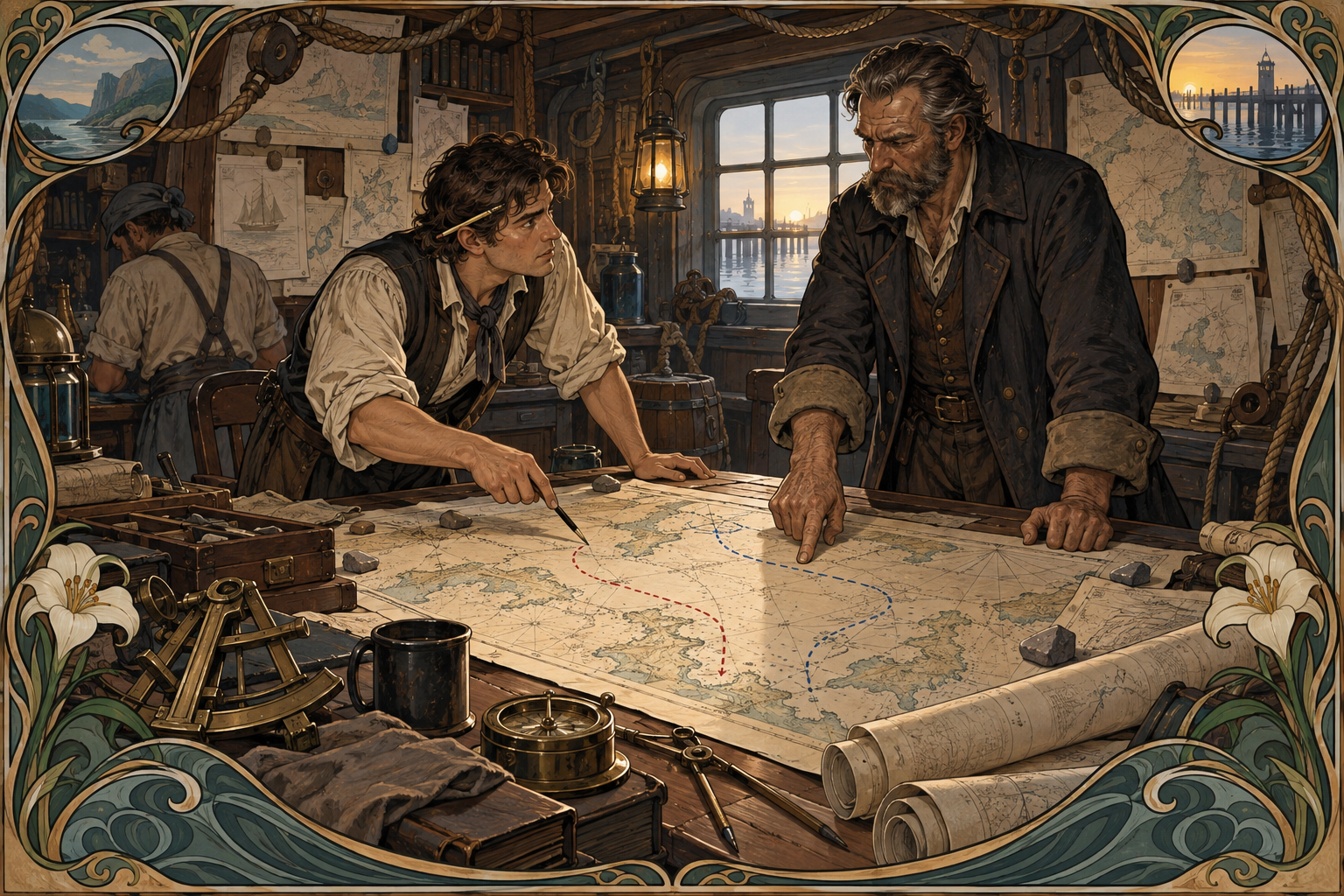
The navigator believed most raids failed with the first line drawn.
Not with a sword. Not with a bad wind. Not even with Captain Amos Trask losing patience at precisely the wrong moment, though all three had ruined respectable plans before. A raid failed when someone looked at a map and mistook the shortest distance for the safest one.
He had been awake all night proving it.
Maps covered the walls of his quarters aboard the Royal Eagle. More lay beneath stones on the huge central table, their corners lifting whenever the ship rocked against the long pier. One chart showed currents. Another showed winds. A third showed what captains claimed the currents and winds had done after cargo disappeared and dockmasters began asking expensive questions.
The navigator distrusted the third chart most. It was also the one he used.
He held a pencil behind one ear and another between his teeth. On the table, two routes left the pier and crossed the warm waters toward the ship spotted off the coast.
The first was direct.
The second looked honest.
Boots struck the corridor outside. The door opened without a knock because Captain Amos considered permission something other people requested from him.
He entered weather-worn and stern, carrying the smell of salt air and the morning deck.
"High tide," he said.
"Still arrives when expected."
"The ship."
"Still off the coast."
"The route."
The navigator removed the pencil from his mouth and pointed to the short line.
"Fastest."
Captain Amos placed one hard finger on it. "Then this one."
"No."
The captain's face had frightened rowdy pirate crews into sudden industry for longer than the navigator had been alive. It did not improve at the word no.
"That line tells them we are coming," the navigator said.
"It is a line on your table."
"It is the line every raider draws. We leave the Ishtar, turn as soon as we clear the fishing boats, take the wind on our port side, and come straight for their stern. They see us change course. They run before we are close enough to lie."
Captain Amos looked at the longer route. It followed the ordinary traffic away from New Thalos, bending with the current before turning gradually toward open water.
"That wastes an hour."
"It spends an hour. We arrive looking like a merchant captain who knows where he is going."
"We are not merchants."
"That is why the course must be convincing."
Above them, men hauled something heavy across the main deck. The crew had spent the morning disguising the Royal Eagle for the raid. Her black flag was down. Bright fittings had been covered. Anything that announced Captain Amos Trask, the Dagger of the Sea, had been wrapped, removed, or told to stop boasting.
The captain studied the two lines.
"If they escape," he said, "I will use your maps for bandages."
"They are not absorbent."
"Then you will be included."
He chose the honest course.
By dawn, the Royal Eagle was awake from bow to stern. Midshipmen swabbed the main deck and complained that work was the only weather they ever saw. Sailors carried lines. The first mate moved through them with the strained authority of a man who had already received six orders and expected the seventh to contradict all of them. Below deck, the cook prepared Gak in a cauldron large enough to feed courage to the whole crew and taste to none of it.
The navigator climbed to the main deck with his charts rolled beneath one arm.
From the mast, the lookout called that the merchant ship remained offshore. Good. A frightened target ran. A comfortable target made plans for lunch.
The tide lifted the Royal Eagle. Fishing boats plying the Ishtar swung toward shore. The long pier settled lower against the hull, and New Thalos began its daily business of selling, taxing, carrying, and denying knowledge of everything that happened near the water.
Captain Amos gave the order.
Lines came free. Sails filled. The Royal Eagle left the pier among the ordinary boats.
For the first half hour, they behaved.
This was harder than violence.
Pirates understood speed, surprise, and the persuasive value of a drawn blade. They did not understand why the navigator ordered less sail when the wind strengthened, or why he kept them behind a broad fishing boat whose nets smelled like every bad decision in the sea.
"We can pass it," the first mate said.
"A merchant would not."
"A merchant has no ambition."
"That is what makes him useful as camouflage."
They held position.
The Royal Eagle crossed the river mouth with the wind steady from the south. Ahead, reddish algae lay across the warm Blood Sea in long loose bands. The navigator watched how the color bent around the fishing boats. It showed him the current more honestly than any arrow on paper.
He changed their heading by a fraction.
The merchant ship was visible now without the lookout's spy-glass: a pale sail, a dark hull, cargo weight pressing her low in the water. She did not turn away.
Captain Amos stood at the center of the aft deck and watched her ignore them.
"Closer," he said.
"Not yet."
"We are losing wind."
"So would an honest ship on this course."
The captain disliked honesty in every form, especially when it slowed him down.
They followed the current. The broad fishing boat turned back toward New Thalos. For a few minutes, nothing lay between the Royal Eagle and her target but open water and good manners.
The merchant crew waved.
Several pirates waved back with so much enthusiasm that the navigator made a note never to let them impersonate ordinary people on land.
The merchant captain altered course to give the Royal Eagle room. It was a small courtesy, exactly the sort that kept ships from colliding and thieves in business. The move placed his vessel where the current crossed the wind. If he tried to flee now, he would have to turn before he could gather speed.
The navigator raised one hand.
Captain Amos had been waiting for it.
The disguise came away.
Dark cloth dropped from bright fittings. Armed men rose from behind the rails. The Royal Eagle's black flag climbed the mast and opened above them, a dagger driven down over skull and crossbones.
The merchant ship tried to turn.
Her sails lost shape. Her hull leaned into the current. For one long moment she seemed to stand still while the Royal Eagle used the same wind to close.
"That," the navigator told the first mate, "is what the hour purchased."
After that, the raid belonged to louder professions.
Ropes went across. Wood struck wood. Men crossed the gap with steel in hand and Captain Amos at their front. The navigator remained aboard the Royal Eagle, calling wind changes nobody heard and watching the merchant ship's sails for signs that someone clever had survived long enough to use them.
The fighting ended before the Gak cooled.
Captain Amos preferred cargo to corpses when cargo could be taken quickly. The merchant crew surrendered their locked chests, barrels, and several indignant crates of fruit. The pirates left them their ship, most of their water, and enough dignity to make the story expensive when they told it ashore.
The navigator was sent to the merchant chart room.
It was smaller than his quarters and better organized. A single map covered the table. Pins marked ports. Pencil lines crossed the Blood Sea in careful curves.
The route they had followed that morning was there.
So were five older routes from New Thalos.
Each had been erased near the coast and redrawn farther south.
The changes were ordinary. No impossible ink. No secret cipher. Just captains giving the Royal Eagle's hunting ground a wider berth after every rumor, late arrival, and missing cargo. The honest passage had been moving a few miles at a time, pushed across the chart by fear.
Their target had not been careless. It had been following the newest safe route.
The navigator rolled the map and carried it to Captain Amos.
The captain stood among captured barrels while pirates counted everything twice and trusted neither total.
"Useful?" Amos asked.
"For today."
"And tomorrow?"
The navigator looked back toward the merchant vessel. Its crew had raised enough sail to limp east. By nightfall, its captain would tell a harbor. By morning, the harbor would tell every trader who bought drinks for the right dockworker.
"Tomorrow this course becomes a pirate's course," he said.
Captain Amos smiled without warmth. "Then draw me another honest one."
On the return voyage, the navigator spread the captured chart across his table. The Royal Eagle rocked through the afternoon while the crew celebrated above and the first mate attempted to turn stolen cargo into an orderly list.
The navigator compared currents, winds, and lies.
Outside his door, the cook carried a crate of fruit toward the kitchen. A seafaring rat followed at a respectful distance. Somewhere on deck, a pirate claimed the raid had succeeded because of courage. Another claimed it had succeeded because of his sword. Captain Amos allowed both claims because neither man had asked for a larger share.
The navigator drew no line.
Instead, he marked the places where merchant captains had stopped sailing. A bend south of the river mouth. A lane beyond the reddish algae. A careful empty strip off the long pier where fishing boats still worked but cargo vessels no longer lingered.
The blank water told him more than the routes.
By sunset, the captured map looked almost unchanged. Only one small dot had been added beyond the latest southern curve.
That was where a cautious captain would turn next week.
The navigator put the pencil behind his ear.
Then he began drawing the next honest lie.