In Gnome Village, a scientist learns that making one thing perfect only gives its damage somewhere else to live.
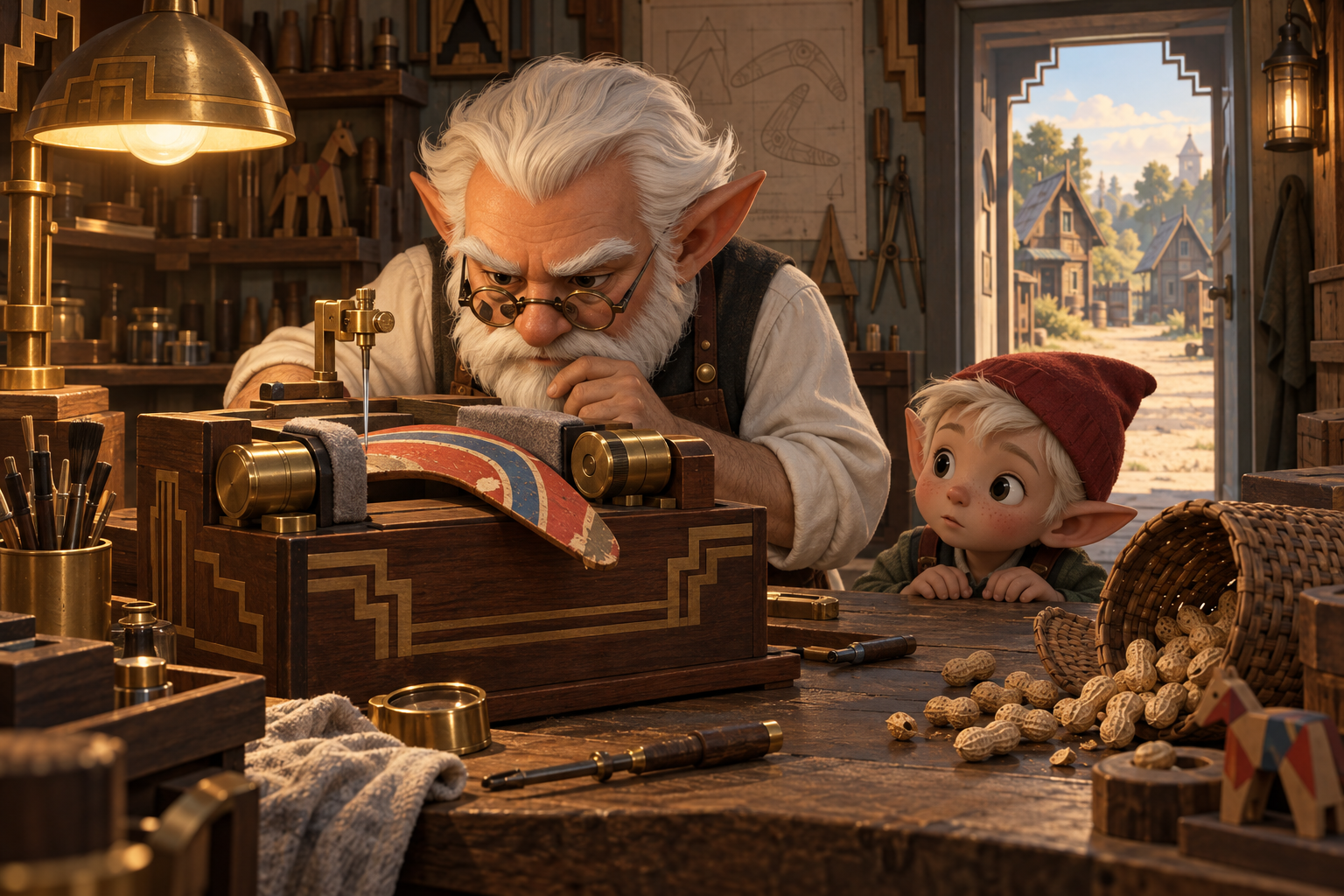
The gnome scientist believed damage was only a measurement someone had failed to finish.
He believed this in the same way the village guards believed in sharp swords and the chief believed in ornate clothes: completely, publicly, and with no patience for questions from taller people.
Each morning he opened one of the three shops beside the dusty road. The wares were fine. The shutters were polished. The sign made it clear that outsiders could admire both from outside. Inside, the scientist repaired what Gnome Village wore out: gnarled staffs, gnome swords, studded shields, and boots built for feet wider than good manners allowed.
He was supposed to be mending a wicker basket when the child arrived.
The basket sat on his bench with peanuts spilling through a split in its rim. Beside it stood the scientist's latest invention, a squat wooden cabinet fitted with two brass rollers, a padded clamp, and a measuring needle fine enough to tremble when someone lied near it. His white hair leaned toward the cabinet as if it were thinking too.
The child held out a toy boomerang.
"It came back broken."
One end had lost a small crescent of painted wood. The fresh chip made the toy turn slightly in the child's hand.
"Things break when thrown," the scientist said.
"Then why make them come back?"
This was the sort of question adults discouraged because it often produced more work.
The scientist placed the boomerang in the padded clamp. He had built the cabinet to compare an object against its own correct shape. The needle traced the curve. The rollers turned. Inside, small tools clicked with the brisk confidence of tools that had not yet met consequences.
The cabinet opened.
The boomerang was perfect.
No patch showed where the crescent had been. No seam interrupted the paint. Even the balance had returned. The child threw it across the shop. It curved between the shelves, missed the scientist's head by a professional margin, and slapped neatly back into a small hand.
"Again," said the child.
"Outside."
The child ran into the road.
The scientist wrote SUCCESS on his slate. Then he noticed the wicker basket.
A fresh crescent had been bitten from its rim.
Three peanuts rolled onto the bench.
He compared the missing piece to his measurements. Same depth. Same curve. Same tiny roughness at the narrow end.
The cabinet had not repaired the boomerang. It had moved the break.
A gnome guard entered before the scientist could decide whether this was failure or a more interesting kind of success. The guard laid a gnome sword across the bench. A notch in the edge caught the light.
"Can you take that out?"
"Yes," said the scientist.
He had not yet learned to stop answering simple questions honestly.
He put the sword in the clamp and moved the wicker basket beneath the bench. This time he watched everything. The needle traced the notch. The rollers turned. The cabinet gave one satisfied little shudder.
The sword came out smooth.
The guard tested the edge with one thumb, nodded, and left.
The shop door now had a sword-shaped notch beside its hinge.
The scientist shut the door. The notch closed with it and opened again when he pulled. He made another note.
REPAIR REQUIRES DESTINATION.
By noon, the bench held enough proof to ruin anyone else's day. A scuff removed from a pair of gnome boots had appeared across a floorboard. A dent lifted from a studded shield had sunk into a tin cup. A crack taken from a bead on a necklace had divided a peanut shell without touching the nut.
The machine chose the nearest thing no one was studying.
That was offensive. A scientist was supposed to be the one deciding what counted as observed.
He carried the cabinet into the road and found the child throwing the perfect boomerang between the small wooden houses. Gnome men walked to work around its flight. Gnome women paused to complain about the risk to windows. The guards watched because guarding something was easier when it kept passing in front of them.
"Give it back," the scientist said.
"It works."
"So does a troll, if the job is breaking furniture."
The child hugged the toy to a small chest. "You said you fixed it."
"I said it was perfect. Those are different problems."
They argued all the way to the Field of Mice's Dreams. Waist-high grass leaned over the path, and field mice scurried beneath it with the private urgency of creatures whose whole world was made of hiding places. Beyond the field, the cold stream trickled west toward its logjam.
The child finally surrendered the boomerang in exchange for a promise that it would not remain broken.
Back in the shop, the scientist placed the boomerang and the damaged basket together inside the cabinet. He reversed the rollers.
The crescent left the basket and returned to the toy.
He paired the sword with the door, the boots with the floorboard, the shield with the cup, and the bead with the peanut shell. One by one, the village's small honest injuries went home. The guard's sword regained its notch. The boots regained their scuff. The child frowned at the chipped boomerang but tested it and found that it still returned.
"Better," said the scientist.
"Worse," said the child.
Both wrote down their result.
The scientist spent the afternoon adding a second clamp to the cabinet. Into it he locked a thick iron disc, plain and useless, made for no purpose except accepting what other things could no longer carry. The machine would not choose a hidden destination now. It would be given one.
He set the chipped boomerang in the first clamp and the iron disc in the second.
The rollers turned.
The boomerang emerged perfect. The crescent appeared in the disc.
The child threw the toy once down the dusty road. It returned cleanly.
"Again," said the child.
"Outside."
By closing time, the iron disc held the day's ordinary damage. One crescent chip. One sword notch. Two boot scuffs. A shallow shield dent. A hairline crack from a necklace bead. The repaired things went home. The disc remained locked in the second clamp, ugly in a useful, accountable way.
The scientist put it in the wicker basket, covered it with peanuts, and carried the basket to a shelf where he could see it from his workbench.
Then he closed the shop.
The next morning, the iron disc was flawless.
The basket had not moved. The peanuts still covered the metal. The cabinet stood open and unwound. Yet the disc shone without a scratch, notch, scuff, dent, or crack.
The scientist checked the repaired objects as their owners passed along the road. The boomerang was still whole. The sword was still smooth. The boots had clean heels. Nothing had taken its damage back.
He searched the shop, then the road, then the small wooden houses. He inspected the chief's carpets and paintings, the fortress gate, the guards' spotless hall, and every shiny plate in the mess hall. Gnome Village had flaws enough, but all of them were old and properly owned.
At sunset, the child found him beside the cold stream.
"Looking for something?"
"A place," said the scientist.
The water trickled west around their boots. Field mice moved through the tall grass behind them. The child threw the boomerang low across the stream, and it curved back without touching the surface.
Where its shadow had crossed, the water divided around a narrow crescent.
There was no stone there. No stick. No bank of mud. Only a dry, chipped shape in the stream, holding its place while cold water bent neatly around it.
The scientist knelt without touching the gap.
Farther downstream, the sunset's reflection carried a thin sword-shaped notch.
He took the perfect iron disc from his pocket and looked at his face in it. For the first time all day, his white hair lay flat.
The child threw the boomerang again.
The stream made room for every flaw.