At Granite Head's Bakery, a miner's order of pot pie, beer, firebreather, and light means the mountain has asked too much.
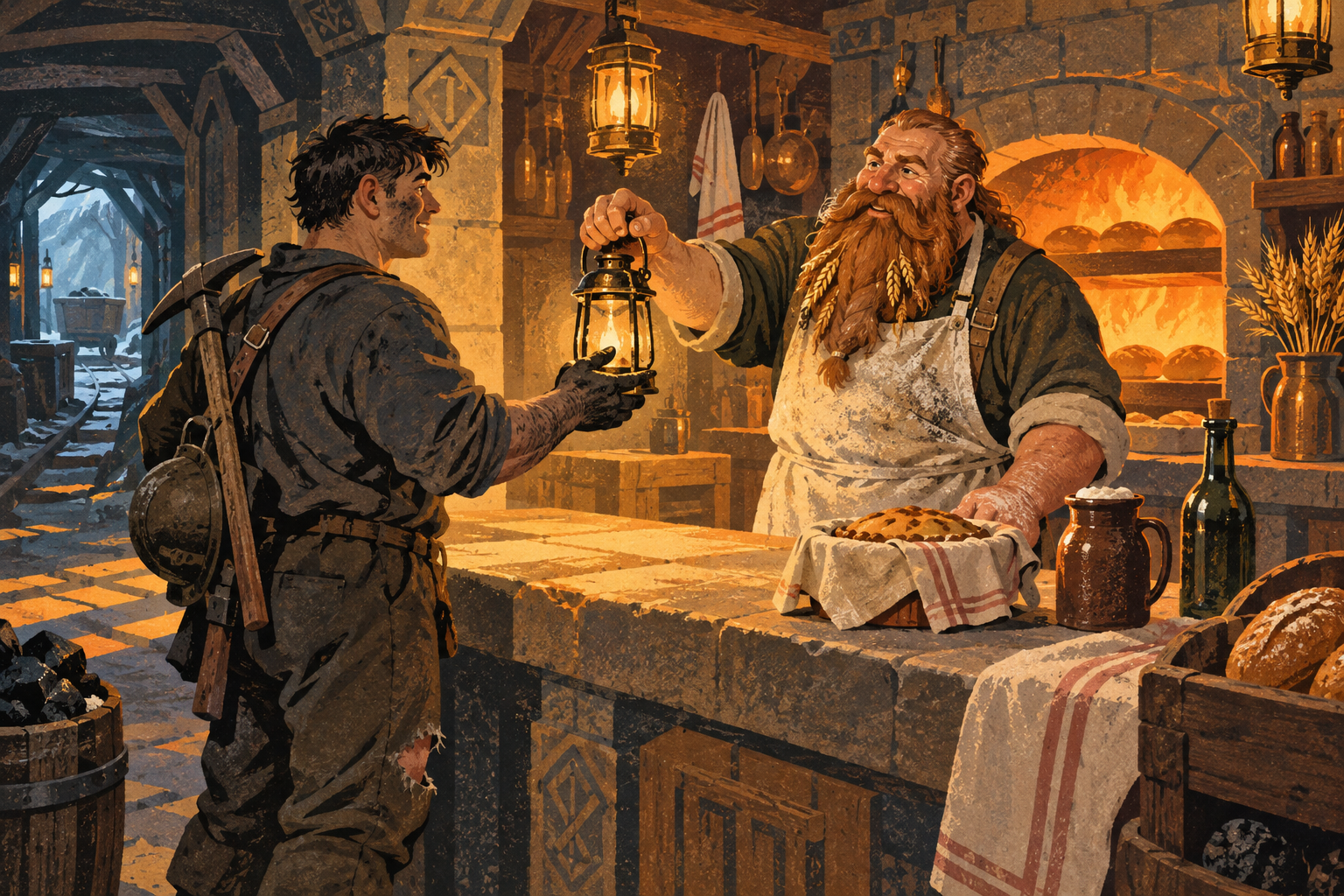
Granite Head was called a baker, though bread was the least of what he sold.
Before the first miners came down the village path, he had pot pies cooling beside the oven, a beer barrel braced beneath the counter, bottles of firebreather lined up where the morning light could not encourage them, and hooded brass lanterns hanging from pegs above the door. Flour covered his apron. Grain clung to his beard. The whole bakery smelled warm enough to make the stone walls seem temporary.
The miners arrived in the order they always did: dirty workers first, dirtier miners second, the mine leader last. They were overworked, broad through the shoulders, and quiet until food gave them back their opinions.
Granite Head knew what each order meant.
A pot pie meant an ordinary shift. A pie and beer meant the shift was over. Firebreather meant somebody had agreed to a plan while sober and regretted it. A brass lantern meant the work would go below the crossroad, where the air grew sooty and every echo sounded employed.
One of everything meant the mountain had asked too much.
The young mineworker who placed that order would not meet Granite Head's eyes. He stood at the counter with coal in the seams of his hands and a fresh tear at one knee of his trousers.
"One of everything," he repeated.
Granite Head wrapped a pot pie in cloth.
"Who told you?"
"The mine leader."
"That is who sent you. I asked who told you."
The worker glanced toward the northern path. Beyond the bakery, the road ran past the hospital and barracks before climbing toward the mines.
"The supports in the Coal Room," he said. "They have been talking all morning."
Granite Head set the pie down. "Wood complains. Stone remembers. Neither one talks."
"Then something has learned both voices."
That answer earned the worker the largest pie on the rack.
Granite Head corked the firebreather, filled a small beer jug, and took down a lantern. Its brass was battered but sound. Tiny letters had been scratched into the bottom by some practical soul who assumed darkness made fools of everyone. Granite trimmed the wick, closed the hood, and put the handle in the worker's blackened hand.
"If the supports begin singing," he said, "do not wait for the chorus."
The worker almost smiled. Then he carried breakfast north.
The bakery filled and emptied around the shape of that order. Barracks guards bought pies and shook crumbs from their beards onto the clean floor. The rotund storekeeper from Hide & Tooth came in complaining that miners wanted steel on credit whenever the mountain misbehaved. The dwarven doctor stopped on his way back to the hospital, steel hands scrubbed pink at the joints, and drank firebreather without sitting down.
"Expecting patients?" Granite Head asked.
"I run a hospital with blood on the walls," said the doctor. "I am always expecting patients."
Near midday, a giant's footsteps rattled the bottles. Granite Head caught two with one hand and a third against his chest. By afternoon, the ordinary workers had returned for beer. The mine leader had not returned at all.
Granite Head began another batch of pies.
He told himself this was business. A baker who worried every time a miner stayed late would burn his crusts and die young. He rolled dough, chopped meat, and listened to the village through the open door: armor from the barracks, a patient swearing in the hospital, the Hide & Tooth bell marking a sale.
Then the mountain struck one dull note.
Flour jumped from the worktable. Every lantern on the wall swung north.
For three breaths the village was silent.
On the fourth, the hospital door opened. The doctor came out carrying his long black healing sticks. Guards ran from the barracks. The Hide & Tooth storekeeper locked his till, unlocked it again, filled a sack with hammers and mithril plate, and shouted that every item was still for sale if anybody survived to pay.
Granite Head rolled the beer barrel into the road.
"Take this," he told the guards. "And the pies."
"We need picks," one said.
"You need both hands for picks. You need a mouth for courage."
He sent every hooded lantern north except the one burning over his counter. Then he fed the people who waited.
Waiting was work no one respected until the mountain made them do it. Granite Head served guards coming back for rope, the doctor coming back for bandages, and workers coming back because they had reached the mine crossroad and found the eastern passage folded shut. He poured beer for wives who did not drink. He reheated pies nobody tasted. He kept the oven hot because cold food on a rescue table looked too much like surrender.
Darkness filled the village outside.
The first miners returned after moonrise, coughing black into clean cloth. More followed with split helmets, bleeding knuckles, and the stunned expressions of people who had heard stone make up its mind. The doctor moved among them, his metal hands gentler than flesh had any right to be.
The young mineworker came last.
Two guards carried him between them. His torn trouser leg was gone below the knee, replaced by a tight bandage. His face was grey with soot. In one hand he held the cloth from Granite Head's pot pie.
In the other, he carried a hooded brass lantern.
Granite Head put water in front of him. "The Coal Room?"
"Gone."
"The bottom shaft?"
"Still there. Mostly."
"The mine leader?"
The worker nodded toward the hospital. Alive, then. Granite Head let his shoulders lower.
"Your lantern brought us out," the worker said.
"That is what lanterns are for."
"Mine was crushed when the supports came down."
He set the brass lantern on the counter.
"This one found us at the bottom."
Granite Head looked at the object. The hood was dented. The handle bore years of smooth wear. Soot blackened the inside of the glass while the outside remained clean.
"Lanterns do not find miners," he said.
"A baker was carrying it."
The bakery quieted.
The worker swallowed water and continued. "Could not see his face. Flour all over him. Grain in his beard. He gave me a warm pie and told me not to wait for the chorus. Then he walked into the dust. We followed the light the other way."
Every face turned toward Granite Head.
He remained behind his counter. Flour covered his apron. Grain clung to his beard. The oven at his back had not gone cold all day.
"You breathed too much mine," he said.
The worker nodded as if grateful for the explanation. No one else spoke.
By dawn, the injured had been moved to the hospital and the rescue crews had gone home. Granite Head swept soot, flour, and pie crust from the floor. He checked the returned lantern against every peg above the door.
It belonged to none of them.
He tried to polish it, but the soot inside the glass would not move. When he opened the hood, the bakery filled briefly with the smell of warm stone after rain.
Granite Head hung the lantern over the oven.
Then he began the morning pies. He made the usual orders first.
Before the miners arrived, he wrapped one extra and left it beneath the strange lantern, where the crust would stay warm.