Above Midgaard, the Grand Knight feels Redferne's flying citadel lose the weight that keeps it honest.
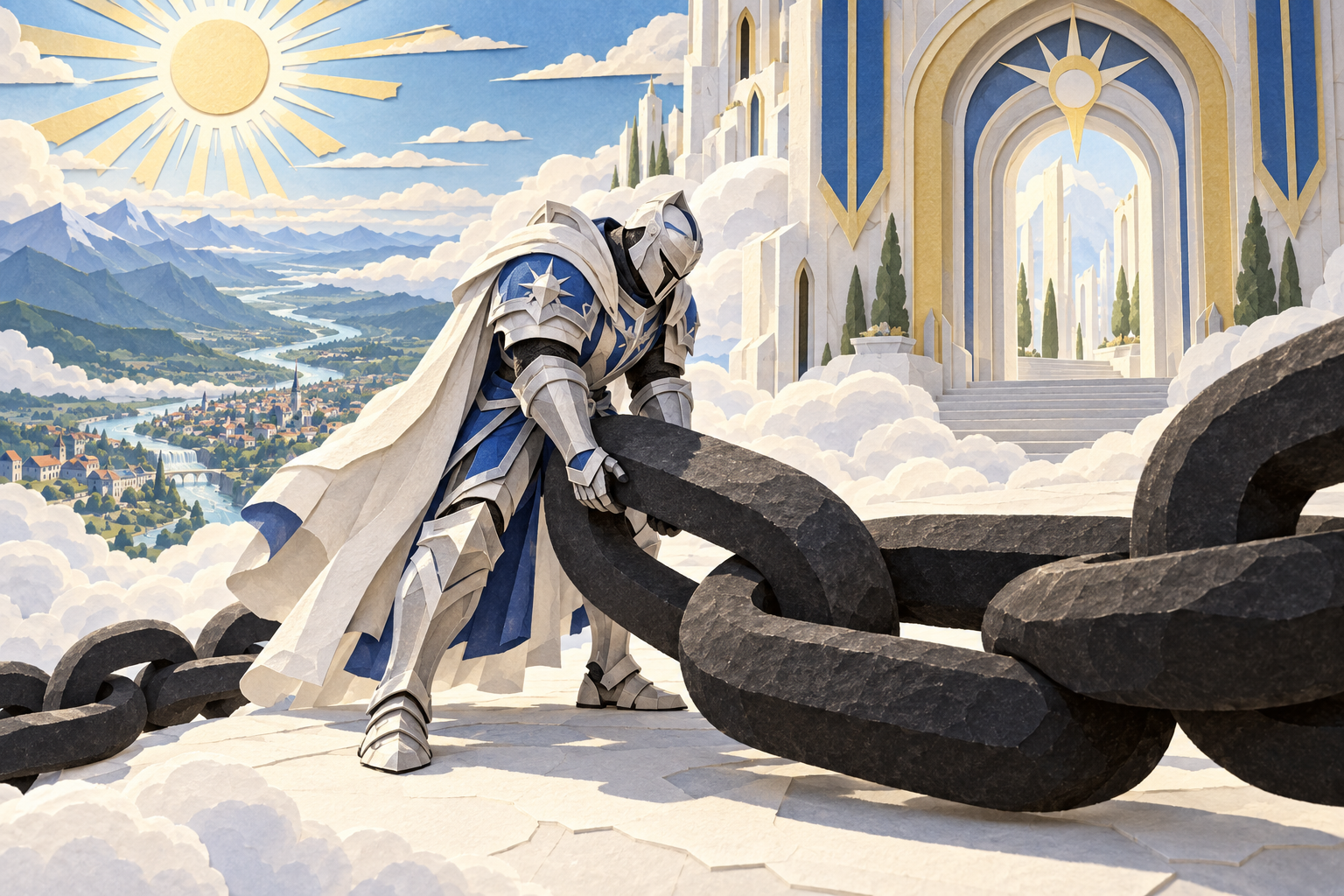
The Grand Knight measured trouble by the chain.
On ordinary mornings it vanished through the cloud beneath Redferne's residence, every black iron link drawn straight toward Midgaard. The chain did not sway. Wind moved banners, cloaks, chimney smoke, and occasionally less careful visitors, but the chain remained a line between the flying citadel and the road crossing far below.
The Knight approved of that.
He stood outside the huge arched gate in white, blue, and silver, ready to help the innocent. This was both an oath and a problem of scheduling. Innocence rarely arrived with an appointment. It came climbing out of the clouds with torn armor, impossible requests, and just enough breath left to explain why somebody else needed saving first.
So he waited.
The cloud plateau held its usual warm sun and absolute stillness. Beneath it, Midgaard made faint city sounds: cart wheels, market calls, a bell marking an hour no one agreed upon. The mansion behind him radiated welcome through walls large enough to make welcome feel compulsory.
Then the chain rang.
The note came up from below.
It passed through the cloud, through the soles of the Knight's boots, and into his teeth. Not the heavy complaint of iron taking weight. This was a bright sound, almost relieved.
One link rose out of the cloud.
Then another.
The chain gathered at the Knight's feet in a slow black curve.
He put one gauntleted hand around the nearest link. It was cold. Worse, it was light. The iron lifted when he lifted it, not like metal as thick as a tree trunk, but like an empty belt someone had left across the floor.
The mansion did not rise.
The cloud did not sink.
Far below, Midgaard continued arguing with itself.
"Hold," the Knight told the chain.
It had never needed the order before.
He drew his sword and crossed through the arched gate. The southern hall was dim despite having no lamps he could accuse. Its walls gave off their patient warmth. The iron-wrought emergency exit stood shut behind him. The tall oak door to the treasure room remained tightly closed beneath its warning to mortals. Nothing pounded from the monster pen. Nothing ran on the enormous stair.
The ashen library door stood open.
The Knight knew he had closed it.
Redferne's Library contained enough books to prove that wisdom and clutter were not enemies. Scrolls leaned together on every shelf. Two worn leather chairs faced a huge oak desk. The crystal chandelier shone without flame.
In the north-western corner, the globe was turning.
Midgaard crossed into view: woods to the west, plains to the east, mountains north, castle road south, and the river cutting through the city toward the Grand Sea. The painted town was no larger than the Knight's thumbnail.
A black line rose from it.
The line was finer than ink and darker than paint. It ran straight away from Midgaard until it reached the top of the globe.
Then it continued down the far side.
The Knight stopped the globe with one hand.
The black line ended in water where no town had been drawn. No island. No road. No name. Only a small iron-colored point in the Grand Sea.
He released the globe.
It began turning the other way.
"That is not an answer," he said.
A book settled on a shelf behind him. One of the leather chairs creaked. The globe completed a slow revolution and offered Midgaard again. The line still passed through it, joining cloud to city to nameless sea as if all three were beads on the same wire.
Outside, another length of chain landed on the cloud.
The Knight returned to the gate. Black links now lay in a loose coil across the plateau. The newest loop had reached the mansion steps.
He sheathed his sword. A sword was excellent for many urgent disagreements, but poor against geography. He took the chain in both hands and climbed down.
The first links passed through bright cloud. The next passed through grey. Soon the mansion disappeared above him, and Midgaard sharpened below: streets, roofs, the river, the road cross at the center of four directions. The chain hung between them without tension.
Halfway down, he found the moving slack.
A loop of chain was climbing toward him.
It rose link by link from below, silent now, carrying no rust and no mark of damage. The Knight braced both boots against the iron and let the loop pass. For one moment he was surrounded by chain going up while he climbed down.
Then gravity remembered itself.
Every link dropped.
The chain snapped taut with enough force to shake the clouds apart. The Knight locked both arms around it. His white cloak cracked like a banner. Below, people at the road crossing looked up, decided the sky was somebody else's responsibility, and kept walking.
He descended until his boots touched stone.
The anchor remained fixed at the center of the crossing. Black iron thicker than a tree trunk entered the road without bolt, seam, or sensible explanation. North and south lay Emerald Avenue. East and west lay Park Road. The sign still named all four.
Someone had added the flying citadel in red paint.
Up — Redferne's Flying Citadel.
Beneath it, in wet black letters, was a new line.
Down —
Nothing followed the dash.
The Knight touched the paint. It stained his gauntlet.
"Who wrote this?"
A fruit seller pointed at a guard. The guard pointed at a child. The child pointed straight down.
The road answered with a knock.
Not a tremor. Not hooves. Three deliberate blows rose through the anchor and into the chain.
The Knight placed one hand against the iron.
Knock.
Pause.
Knock knock.
He answered once with the pommel of his sword.
The chain went weightless again.
For a single breath the enormous links floated above the crossing. People screamed then, which the Knight considered progress. Carts stopped. Guards remembered their jobs. The child laughed and reached for an iron link hovering at eye level.
The Knight caught it first.
"Back."
He pulled down.
At first, the chain refused. He had lifted gates, horses, wounded warriors, and one collapsed chapel roof. None had resisted like this. The chain did not fight his strength. It ignored the direction.
Then the city joined him.
The nearest guard seized a link. The fruit seller seized the guard. A carter wrapped both arms around the next length. Two merchants, three children, a thief who claimed he had only been passing, and an old woman with no patience for airborne iron added their weight.
The chain descended an inch.
From somewhere below the road came a sound like a great link dragged across stone.
The chain fell.
Its weight returned all at once. The Knight shouted for everyone to release it. Iron struck the anchor with a crack that sent birds from roofs all along Emerald Avenue. The line overhead pulled straight, black, and ordinary toward the clouds.
The new paint on the sign dried instantly.
Down —
The dash remained.
By sunset, the Grand Knight had climbed home.
The flying citadel stood where it had always stood. The cloud plateau was warm. The mansion windows shone. In the library, the globe had stopped with Midgaard facing outward.
The black line was gone.
At the iron-colored point in the nameless sea, someone had painted a tiny ring.
The Knight returned to his post outside the arched gate. Below the cloud, Midgaard settled into evening. The chain held firm beneath his hand.
He resumed waiting for someone to help.
Near midnight, the chain gave three soft knocks.
This time, they came from above.